


Example 5
From Applications to Platform Technology: A Hybrid Ultrasonic–Mechanical Mixing Concept
Motivation and Technological Context
Power ultrasound offers strong potential for process intensification in a wide range of operations involving fluid media, where cavitation, acoustic streaming, and enhanced mixing can significantly improve process efficiency and control.
However, many industrial ultrasonic systems still rely on conventional architectures, such as horn-type transducers that deliver highly localized cavitation zones, or ultrasonic baths that act over larger volumes but typically at much lower acoustic intensities. While ultrasonic baths are well suited for cleaning applications, they are often less effective for more demanding or intensive processes.
Horn-based systems can be highly effective at small scale, but when applied to larger volumes or more complex processes they often face limitations including uneven energy distribution, cavitation shielding, erosion of radiating surfaces, and limited scalability. These constraints may be partially mitigated through recirculation loops or by combining ultrasound with mechanical agitation; however, such solutions are often complex and suboptimal.
These limitations motivated the exploration of alternative system architectures capable of combining the benefits of ultrasonic cavitation with improved macroscopic mixing and more uniform energy distribution. Achieving this requires a deep understanding of resonant ultrasonic systems, as well as the ability to exploit different vibration families and modal couplings in a controlled and effective manner.
Identified Limitations of Conventional Ultrasonic Mixing Approaches
Traditional ultrasonic mixing systems typically rely on longitudinal vibration modes and acoustic emission from a single radiating surface. Such configurations may suffer from:
- Strong spatial gradients of acoustic intensity
- Limited penetration depth of cavitation effects
- Shielding phenomena due to bubble clouds
- Sensitivity to vessel geometry and scale
- Reduced effectiveness when scaling beyond laboratory volumes
These factors can limit both process efficiency and robustness, particularly in applications requiring homogeneous treatment of the entire volume
Concept Overview: Hybrid Ultrasonic–Mechanical Mixing
To address these challenges, a hybrid concept was developed, combining classical mechanical agitation (e.g. stirring) with power ultrasound within a single integrated device.
The system consists of a central ultrasonic transducer operating in a torsional vibration mode, mechanically coupled to a set of mixing blades designed to vibrate in flexural modes. This configuration enables the simultaneous generation of:
- Bulk flow and macroscopic mixing driven by blade motion
- Localised ultrasonic vibration at the blade surfaces
- Distributed cavitation and acoustic streaming throughout the vessel
A schematic comparison between a conventional ultrasonic horn and the proposed hybrid concept is shown in Figure 1, illustrating the transition from point-based ultrasonic energy delivery to a more distributed, volume-oriented approach.
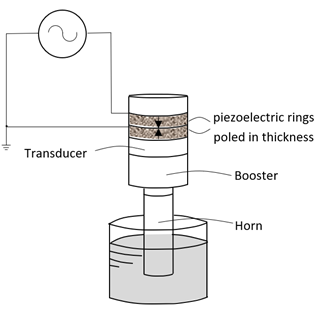
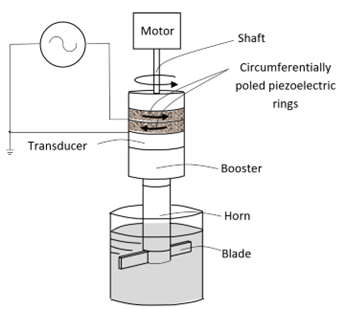
Figure 1. Schematics of ultrasonic system configurations: (a) longitudinal horn-based device; (b) torsional-flexural composite mode bladed device
Design Features and Numerical Modelling
The hybrid system was designed to allow flexibility in blade geometry, number, and length, enabling adaptation to different vessel sizes and process requirements. FE modelling and experimental testing were combined to:
- Tune the coupled torsional–flexural vibration modes
- Validate resonance frequencies and mode shapes
- Assess stress levels and mechanical integrity
- Predict acoustic energy distribution in the liquid
Representative mode shapes of the coupled system are shown in Figure 2, highlighting the effective transmission of ultrasonic vibration from the transducer into the blade assembly.
Hydrophone-based measurements further demonstrated that the hybrid configuration produces a more spatially distributed acoustic field compared to conventional horn systems.
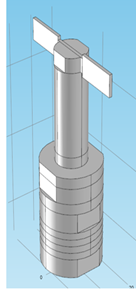

Figure 2. FE model of the ultrasonic bladed device: (a) undeformed configuration, (b) mode shape of the tuned mode
Experimental Proof of Concept
A laboratory-scale prototype was manufactured and tested in liquid media to assess cavitation activity, mixing behavior, and system-level performance.
A representative visualization of cavitation and acoustic streaming generated by the hybrid mixer is provided in Figure 3 (as an animation), whereby the combined effects of blade-induced flow and ultrasonic excitation can be clearly observed in the liquid medium.
Figure 3. Animation of acoustic cavitation and streaming effects (no rotation)
Additional experiments using sodium chloride crystallization as a representative model process showed the presence of multiple active cavitation regions distributed along the vibrating blades, rather than confined to a single emission point. High-speed visualization and hydrophone measurements indicate enhanced acoustic activity across a larger fraction of the vessel volume.
Comparative tests were carried out at two excitation levels against using the prototype device and a conventional ultrasonic horn, with and without stirring. Testing outcomes showed differences in crystal morphology and size distribution consistent with a more homogeneous ultrasonic treatment (Figure 4).
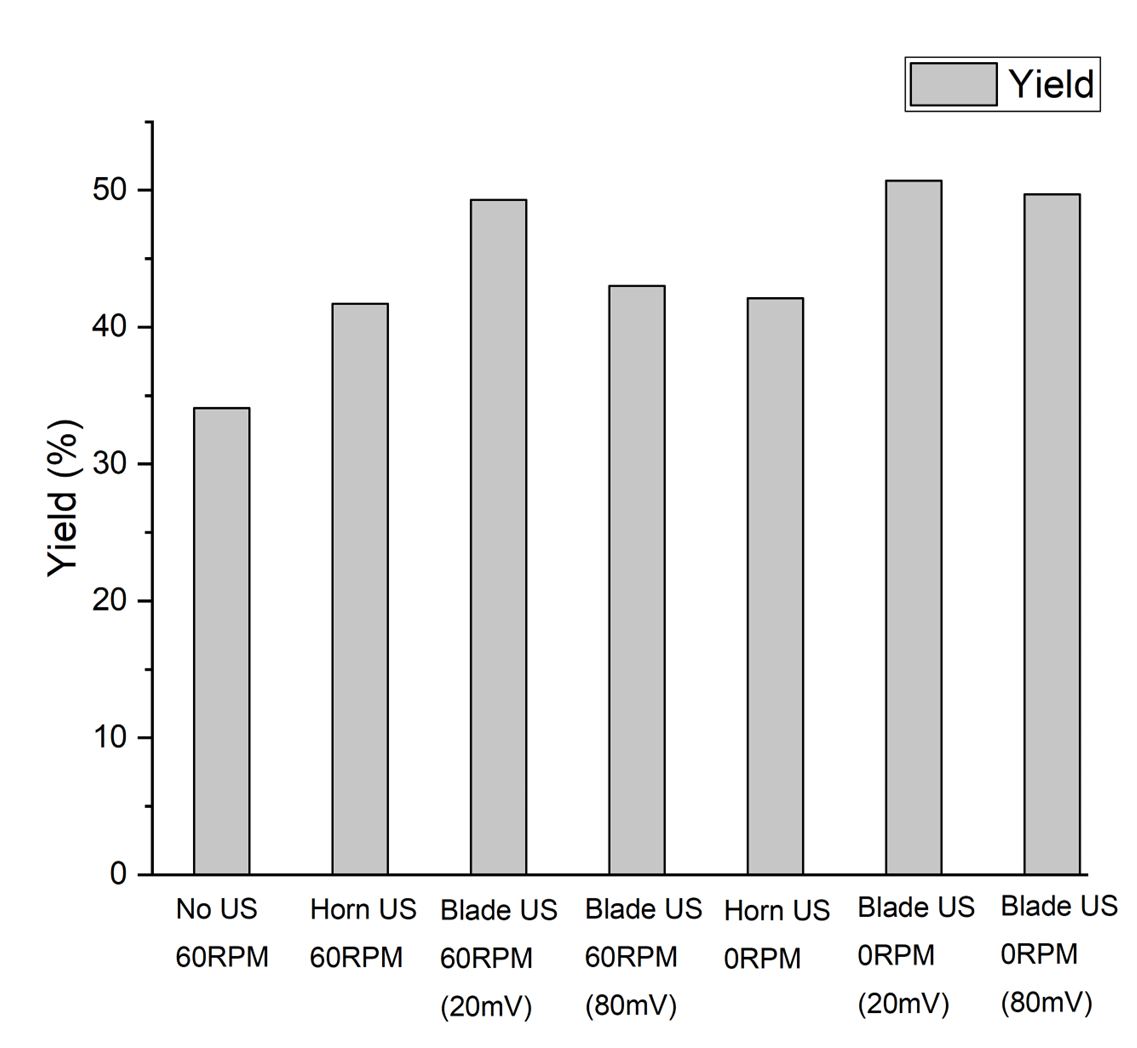
Figure 4. Yield of crystal nuclei formed through the bladed and horn based ultrasonic system set ups. mV refers to the voltage applied by the function generator prior to signal amplification to the bladed device at its tuned frequency
Outcome and Technological Relevance
This work demonstrates the feasibility of a hybrid ultrasonic–mechanical mixing concept that moves beyond application-specific solutions toward a more general technological platform.
Key outcomes include:
- A system architecture capable of distributing ultrasonic effects throughout the treated volume
- Reduced reliance on highly localised cavitation zones
- Enhanced flexibility through modular blade design
- Applicability to multiple processes, including mixing, emulsification, degassing, and crystallisation
While the development was carried out at laboratory scale, the results highlight strong potential for further optimisation and adaptation to pilot and industrial environments. In particular, ongoing trends toward continuous manufacturing — where compact systems process materials in a steady and controlled manner rather than in large batch vessels — underline the relevance of scalable, flexible, and energy-efficient ultrasonic system architectures.
Positioning Within ACTV’s Expertise
The development presented here serves as a bridge between individual application-driven developments and the concept of scalable ultrasonic platforms. It reflects an approach centred on system-level thinking, combining deep understanding of ultrasonic physics with design flexibility and cross-sector knowledge.
The further evolution of such concepts naturally benefits from collaborative development approaches, where complementary expertise and industrial insight can be brought together to explore new application domains and manufacturing strategies.