


Example 4
Ultrasonic Emulsification and Bacterial Inactivation
Motivation and Industrial Context
The preparation of fine, stable emulsions and the control of microbial load are critical operations in liquid formulations used in pharmaceuticals, nutraceuticals, cosmetics, and advanced liquid processing applications. These processes directly affect product stability, safety, shelf life, and functional performance.
Conventional emulsification and sterilization techniques often rely on high shear mixing and aggressive thermal treatments, which may compromise sensitive ingredients or require complex downstream processing. In this context, power ultrasound represents an attractive alternative or complementary technology, offering intense localized mechanical effects while operating under comparatively mild bulk conditions.
This project explored the feasibility of applying power ultrasound to liquid formulations representative of this industrial domain, with the dual objective of enhancing emulsification performance and reducing microbial load through predominantly physical mechanisms.
Scientific and Technical Background
Power ultrasound in liquids generates intense acoustic cavitation, characterized by the formation, growth, and collapse of microbubbles. These events produce localized high shear, micro-jets, shock waves, and strong acoustic streaming.
In emulsification processes, these phenomena promote droplet breakup and rapid homogenization, often leading to submicron droplet sizes and improved emulsion stability. In parallel, cavitation-related mechanical stresses can damage microbial cell structures, increasing susceptibility to inactivation, particularly when combined with moderate temperature or pressure.
Previous studies have shown that ultrasound-assisted processes can intensify mass transfer and mechanical effects, opening opportunities for hybrid strategies that reduce reliance on severe thermal treatments while maintaining process effectiveness.
Ultrasonic System Design and Numerical Modelling
A dedicated laboratory-scale ultrasonic system was designed to enable controlled batch experiments, with the possibility of future adaptation to batch–recirculation configurations (Figure 1 and Figure 2). The system incorporated a custom-designed power ultrasonic transducer, mechanical amplifier, and probe, operating in longitudinal resonance around 20 kHz.
Finite Element Method (FEM) simulations were extensively employed to guide the design and optimization process (Figure 1). The ultrasonic assembly and its interaction with the liquid medium were modelled to predict:
- resonance frequencies and modal shapes,
- stress and displacement distributions,
- acoustic pressure fields and induced streaming patterns.
The numerical results revealed strong acoustic streaming and pressure fields consistent with effective mixing, cavitation activity, and droplet disruption (Figures 3).
Predicted resonance frequencies and electrical impedance characteristics of the ultrasonic assembly radiating in liquid revealed good agreement with experimental impedance measurements. This confirmed the reliability of the numerical models as design tools.
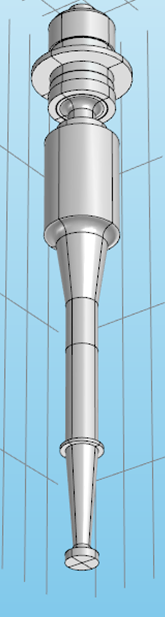
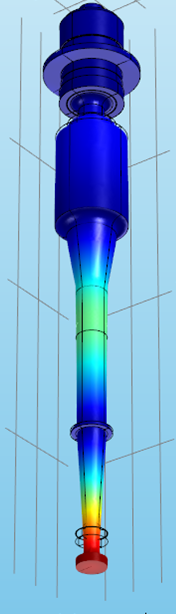
Figure 1. Ultrasonic Defoaming System: (a) 3D model; (b) longitudinal modal shape calculated using Comsol

Figure 2. MTS apparatus
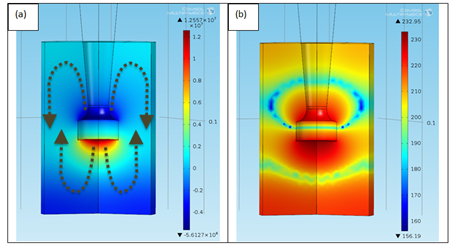
Figure 3. Predicted acoustic field: (a) mixing by acoustic streaming; (b) pressure field
Experimental Activities and Key Observations
Laboratory-scale tests were conducted using water as a reference medium during initial characterization, followed by experiments with representative oil–water formulations containing emulsifying agents relevant to medical and nutraceutical liquid products.
Ultrasound proved highly effective in producing fine emulsions, with droplet sizes reaching the submicron range. Increasing probe vibration amplitude significantly reduced processing times, highlighting the dominant role of cavitation intensity and acoustic streaming in emulsification efficiency.
Preliminary microbial inactivation tests showed that ultrasound could induce substantial bactericidal effects for selected strains under specific operating conditions. While complete inactivation was not achieved across all cases, the results clearly indicated that mechanical effects associated with cavitation played a primary role, particularly under sub-lethal thermal conditions. These findings supported the rationale for hybrid approaches combining ultrasound with moderate heat or pressure.
Visual evidence from laboratory observations and video recordings (shown in the animation of Figure 4) confirmed intense cavitation activity, droplet breakup, and fluid motion. The observed phenomena were fully consistent with the acoustic field distributions and streaming patterns predicted by FEM simulations (Figure 3).
Figure 4. Animation of emulsification of oil in water
Outcome and Relevance
This laboratory-scale pilot study demonstrated the potential of power ultrasound as a flexible and effective tool for both emulsification and microbial load reduction in sensitive liquid formulations.
The work highlighted the critical influence of ultrasonic system geometry, probe design, positioning, operating frequency, and vibration amplitude on process performance. Rather than relying on generic solutions, the results reinforced the importance of application-specific ultrasonic design tailored to the target process and constraints.
Overall, the project showcased a robust modelling-to-prototype workflow and illustrated how power ultrasound can be adapted to complex liquid-processing challenges, laying the groundwork for further development of ultrasound-assisted emulsification and hybrid, non-conventional microbial control strategies.